
Author: Alexandre Dauphin (VP Quantum Materials)
TL;DR – Using a 256-qubit Rydberg-atom quantum processing unit (QPU), we prepared a two-dimensional quantum magnet, suddenly changed its Hamiltonian and watched it relax. The system followed three paths. It could thermalize rapidly, remain in a long-lived prethermal state, or relax much more slowly than expected.
The slow regime appeared precisely where three leading tensor-network calculations stopped agreeing at late times. The QPU results remained consistent across system sizes, giving us access to the dynamics after the classical calculations had lost control.
Quantum magnets out of equilibrium
A quantum magnet consists of interacting spins whose tendency to order competes with quantum fluctuations. The underlying rules can be simple, while the collective behavior is remarkably rich.
Following this behavior after a quench is particularly difficult in two dimensions. Correlations and entanglement spread across the lattice, making an accurate classical representation increasingly costly as time evolves.
The two-dimensional transverse-field Ising model isolates the relevant competition. Ferromagnetic interactions favor aligned spins, while a transverse field drives quantum fluctuations. Its equilibrium phases are well known, but its relaxation after a quench—particularly near the dynamical phase transition—is much less understood.
The 256-qubit experiment
The same platform had previously been used to simulate TmMgGaO₄, a frustrated quantum magnet, with up to 256 qubits. Its results were compared directly with magnetic measurements from a physical TmMgGaO₄ crystal. The benchmark came from the material itself.
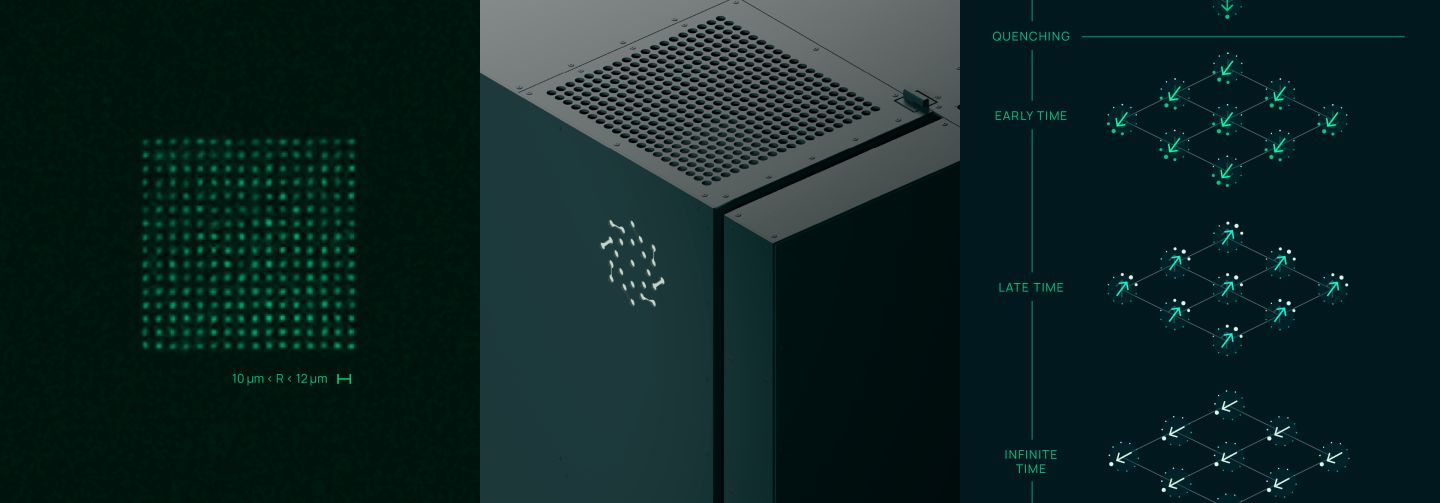
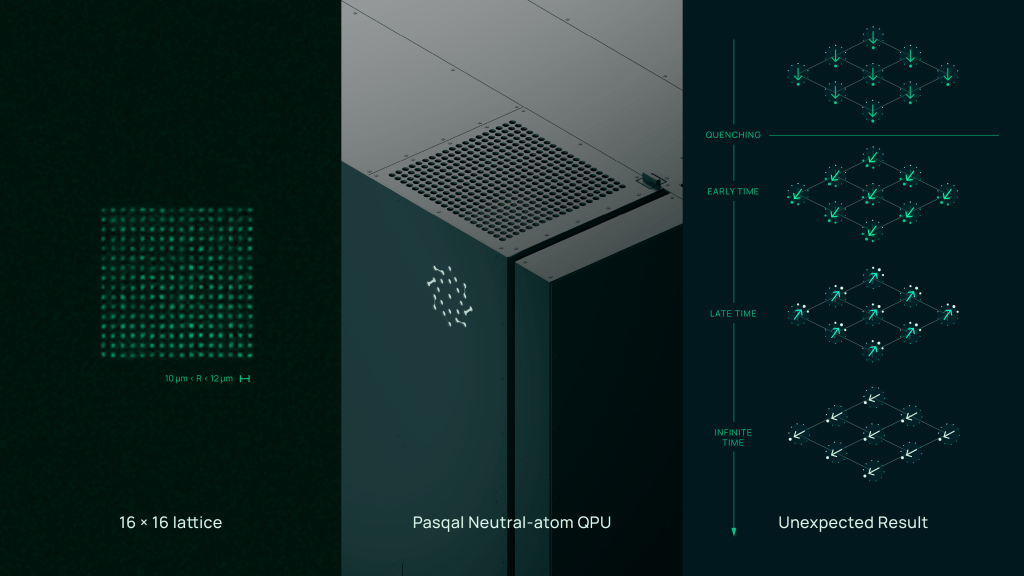
For the present study, we used the same hardware to address an open and challenging problem. We arranged 256 rubidium atoms in a 16 × 16 square lattice and used their ground and Rydberg states to encode the two spin states of the transverse-field Ising model. Laser coupling produced the transverse field, while interactions between Rydberg atoms provided the ferromagnetic coupling.
We prepared the array in a fully polarized state and then suddenly changed the transverse field. Repeating this quench at different field strengths allowed us to follow the magnetization and correlations across the phase diagram, and to map how the system relaxed in each regime.
Three relaxation regimes
As we increased the transverse field, three distinct forms of relaxation appeared.
Rapid thermalization. When the transverse field and the interactions had comparable strengths, the system quickly approached its thermal values. This is the expected behavior of a generic non-integrable many-body system: local observables lose memory of the initial state and relax on the natural timescale set by the interactions.
Slow relaxation. At intermediate field strengths, the correlations continued to evolve toward equilibrium, but much more slowly. The origin of this slowdown remains unresolved. It may reflect both the breakdown of the effective high-field description and critical slowing near the thermal transition.
Prethermalization. At large transverse field, rapid spin precession produced dynamics governed by an effective XY model. The system reached a long-lived prethermal plateau and remained there throughout the experimentally accessible timescale. It is expected to thermalize eventually, but only at much later times.
Testing the result
The slow regime could reflect genuine many-body dynamics, but its measured decay could also be affected by the finite array or by imperfections in the QPU. We tested these effects separately.
At early times, fully converged two-dimensional tensor-network calculations agree quantitatively with the 16 × 16 QPU data up to tJ ≈ 1. Exact state-vector simulations on smaller 5 × 5 lattices also recover the same three regimes, including slow relaxation in the absence of noise.
We then modeled the main experimental imperfections: state-preparation and measurement errors, fluctuations in the Hamiltonian parameters and dephasing. Their strengths were obtained from independent calibrations. Simulations including these effects are consistent with the QPU measurements.
The remaining uncertainty is quantitative. Noise and system size affect the measured relaxation rate, especially in the slow regime. They do not account for the qualitative separation between rapid thermalization, slow relaxation and prethermalization, which is also present in ideal simulations. The QPU results remain consistent as the system size increases.
The limits of tensor-network simulations
Tensor-network methods simulate a quantum system by compressing its entanglement. At early times, these calculations agree closely with the QPU and provide a reliable reference. As entanglement grows after the quench, maintaining that accuracy becomes increasingly difficult.
In the slow-relaxation regime, three different tensor-network calculations eventually separate from one another. Their mutual disagreement becomes as large as their disagreement with the QPU, so they no longer provide a controlled description of the late-time dynamics.
The QPU results remain consistent across system sizes and continue to show a slow approach toward thermal equilibrium. They allow us to follow the relaxation beyond the time range that these calculations can reliably reach.
Effective XY dynamics
At large transverse field, rapid spin precession changes the effective interaction. In a rotating frame, the Ising Hamiltonian is well described by a U(1)-symmetric, rotated XY model. This accounts for the prethermal plateau.
Access to a second Hamiltonian on the same hardware broadens the range of magnetic symmetries and anisotropies that can be represented. We now want to connect this capability to real materials: identify compounds described by Ising- or XY-like models and compare QPU observables directly with experimental measurements, following the approach used in our earlier work on TmMgGaO₄.
What comes next
The origin of the slow-relaxation regime remains unresolved. It may result from the interplay between the breakdown of the high-field prethermal description and critical slowing near the thermal transition. Finite-size effects and noise also influence the measured decay rate. Separating these contributions will require systematic measurements across larger system sizes and longer evolution times.
Reducing noise and extending coherence times would help distinguish intrinsic many-body relaxation from experimental effects. It would also allow us to characterize the crossover regime more precisely and follow the prethermal plateau over longer times. Improved classical calculations could provide additional reference points at intermediate sizes and times. The present study maps the three regimes; the next step is a quantitative theory of the crossover between them.
Frequently asked questions
What exactly was unexpected?
At intermediate transverse-field strengths, the correlations relaxed much more slowly than expected. This regime lies between rapid thermalization and high-field prethermalization. Its physical origin has not yet been fully explained.
How was the slowdown checked?
The same qualitative behavior appears in ideal small-system simulations without noise. The experiment was also compared with a noise model based on independent calibrations and with fully converged tensor-network calculations at early times. Noise affects the measured relaxation rate, but it does not produce the three-regime structure.
Does this demonstrate quantum advantage?
No computational-advantage claim is made. The study does not compare runtimes or computational costs. It identifies a regime in which the tensor-network calculations used in the study cease to provide controlled late-time predictions, while the QPU results remain consistent across system sizes.
Why is the effective XY model interesting?
At large transverse field, the Ising dynamics are described by a U(1)-symmetric, rotated XY model. This means that the same Rydberg platform can probe different classes of spin dynamics and represent a broader range of magnetic systems.
Where can I read the paper?
The full study, Exploring the Relaxation Landscape of a 2D Quantum Magnet on a 256-Qubit Processor, is available as a preprint on arXiv.
Collaboration
This work was carried out by researchers at Pasqal, the Flatiron Institute, the University of Augsburg, Forschungszentrum Jülich, the University of Regensburg and Institut d’Optique–CNRS.

