
Authors: Corentin Monmeyran, Adrien Signoles, Lucia Garbini
Neutral atom quantum computers rely on large, defect-free arrays of atoms to run analog and digital computations. Each atom encodes a qubit. Last year, we demonstrated defect-free 506-atom registers (see our 506-atom blog post).
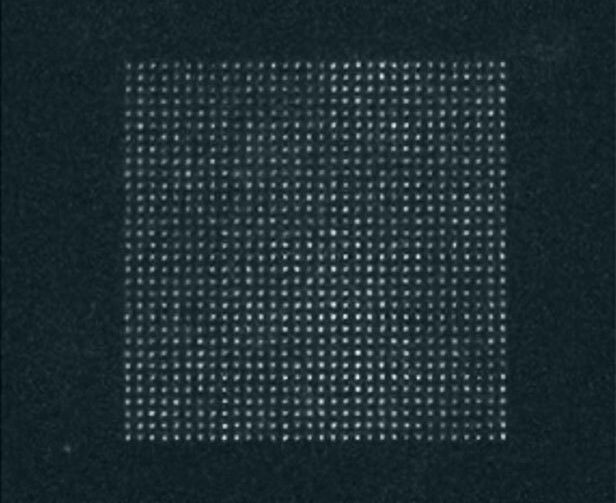
We’ve now achieved 1024-atom, defect-free registers. This milestone pushes neutral atom systems to the scale needed for a broad range of applications. For the full technical details, see our preprint on arXiv.
Why scale matters
Scaling to 1000 atoms unlocks capabilities that aren’t possible at smaller sizes.
For analog computation, more atoms mean larger system sizes: simulating materials with more unit cells, spin models with more sites, or solving larger optimization problems. This translates directly into tackling bigger, larger-scale problems in materials science, chemistry, and industrial optimization.
For digital computation, more qubits provide sufficient overhead for quantum error correction, bundling many physical qubits into one logical qubit that protects against noise. This is the path to fault-tolerant quantum computing (FTQC).
Beyond application potential, reaching 1000 atoms is a critical scalability test. At this scale, we verify that our approach, uniform traps, fast manipulations, efficient rearrangement, works when doubling from 506 atoms, and we identify the operational bottlenecks to scale even further, opening the path towards thousands of qubits.. Testing FTQC on a full, end-to-end application is the next critical step.
Overcoming Scaling Challenges
Building on our 506-atom operational excellence, uniform high-quality traps, fast manipulations, efficient intermediate steps, we faced two key challenges when scaling to 1024 atoms:
Insufficient laser power: Our single-laser setup couldn’t generate enough traps for 1000+ atoms. Solution: We combined two lasers through separate spatial light modulators, doubling available power and generating over 2000 traps for 1024-atom loading.
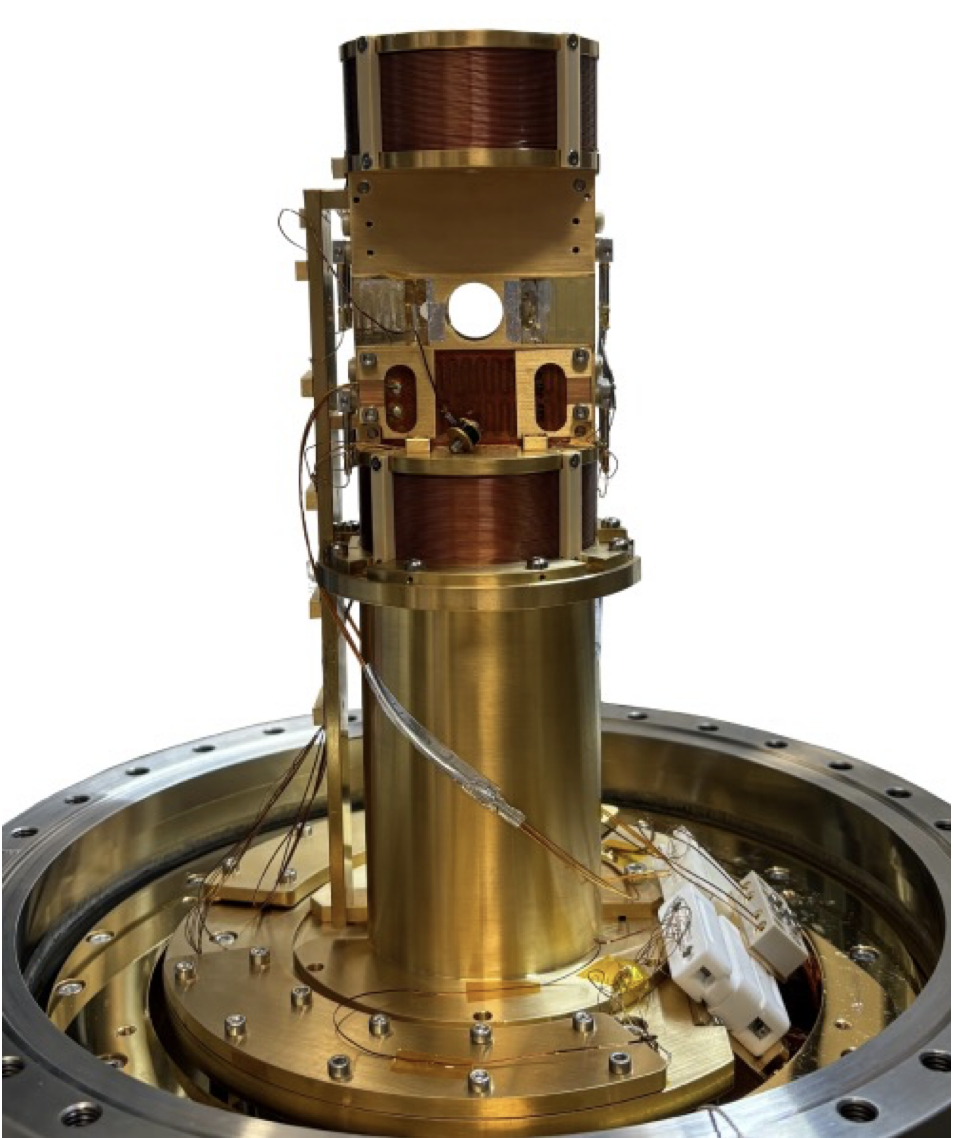
Insufficient vacuum quality: Our previous setup could not maintain a sufficiently low pressure, limiting the atom lifetimes to a few hundred seconds. Solution: We redesigned a 4 K cryogenic platform with 4 K/30 K shielding, in-vacuum optics and an improved cryogenic pumping. This significantly extended the atom lifetimes.
The Results: 1024 Atoms, less than 0.5% Defects, 5000-Second Lifetimes
The hardware upgrades delivered significant performance improvements. We were able to prepare 1024-atom registers combining the techniques above with a two-step rearrangement process.
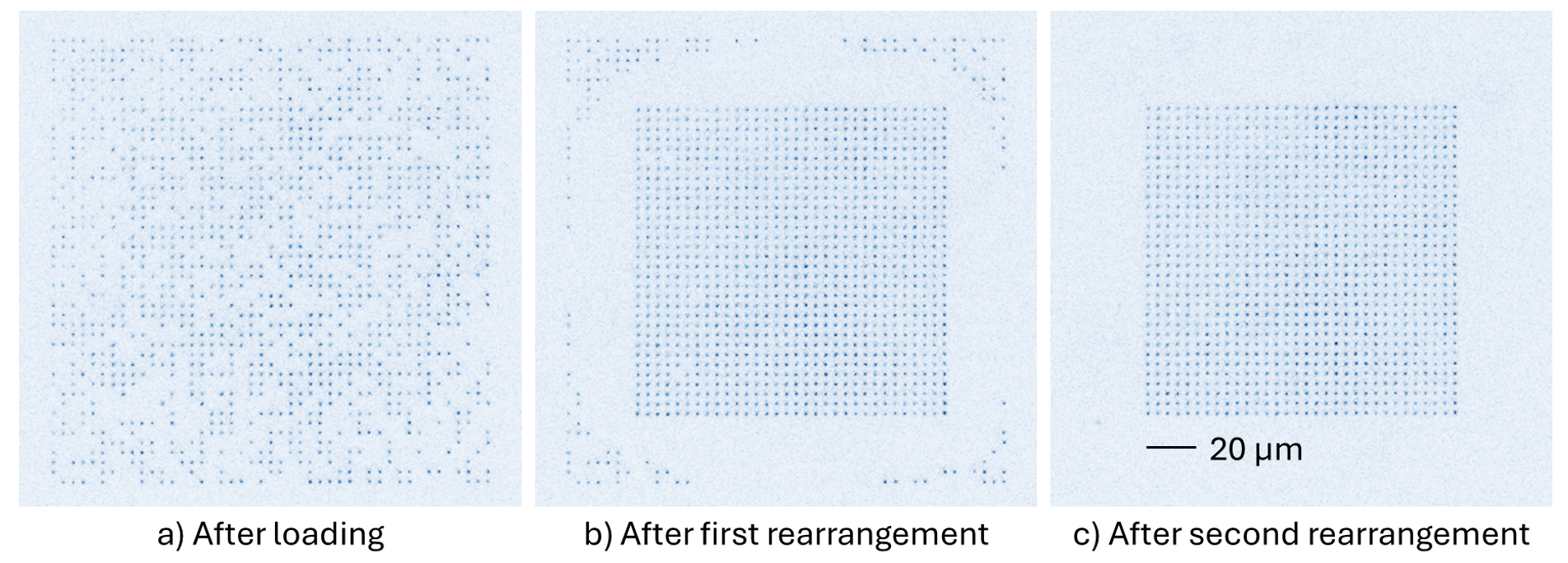
First, we capture an image to see which traps contain atoms, then use an algorithm to plan the most efficient moves that fill the register while avoiding collisions. Since some atoms are still missing after the first round of transport, we run a second rearrangement cycle to fix the gaps that this creates and hence achieve defect-free registers. Roughly 10% of runs yield fully defect-free arrays, and 95% have fewer than 0.5% of defects. With such results we demonstrate that operational excellence combined with cryogenic engineering delivers large, high-fidelity qubit arrays.
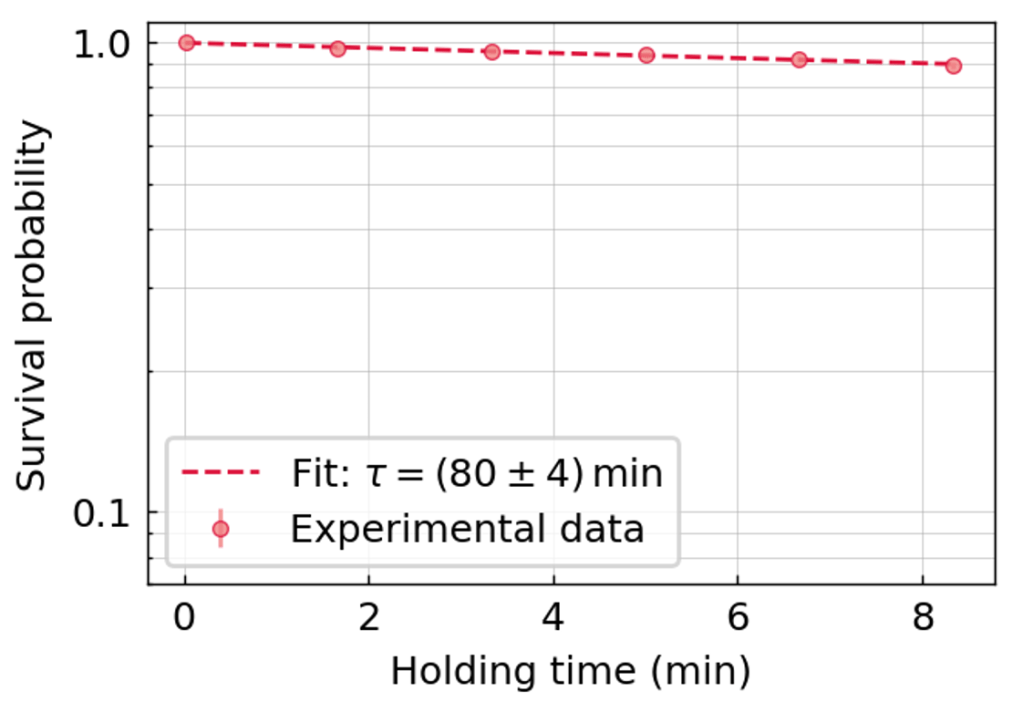
The cryogenic platform delivered a major performance gain: atom trapping lifetime reached about 5000 seconds (80 minutes), a 40× improvement over the previous cryogenic setup. This limits the emergence of defects while preparing the register. The cryogenic environment will also improve fidelities for both analog and digital computations since it allows for suppressing blackbody radiation, extending the Rydberg state lifetime and hence reducing errors during processing.
“Our team has demonstrated the preparation of 1024-atom register with very low averaged defect rate. This result shows that our neutral-atom platform can scale to the thousands of qubits, opening the path to large-scale quantum computing.”
Adrien Signoles, Chief Hardware Officer at Pasqal
Looking ahead
Using 1024 atoms, we demonstrated a critical milestone: defect-free registers at the thousand-atom scale are achievable with neutral atoms. Building on this foundation, continued improvement on operational excellence and cryogenic environments will enable more reliable control, longer coherence times, and the implementation of error-corrected quantum computation.
This milestone demonstrates that large, defect-free neutral atom arrays are now a reality. We’re transitioning from intermediate-scale demonstrations to systems with the scale and quality required for increasingly complex applications. The full scientific paper is available now on arXiv.
1024 defect-free atoms are here, and scaling continues.