
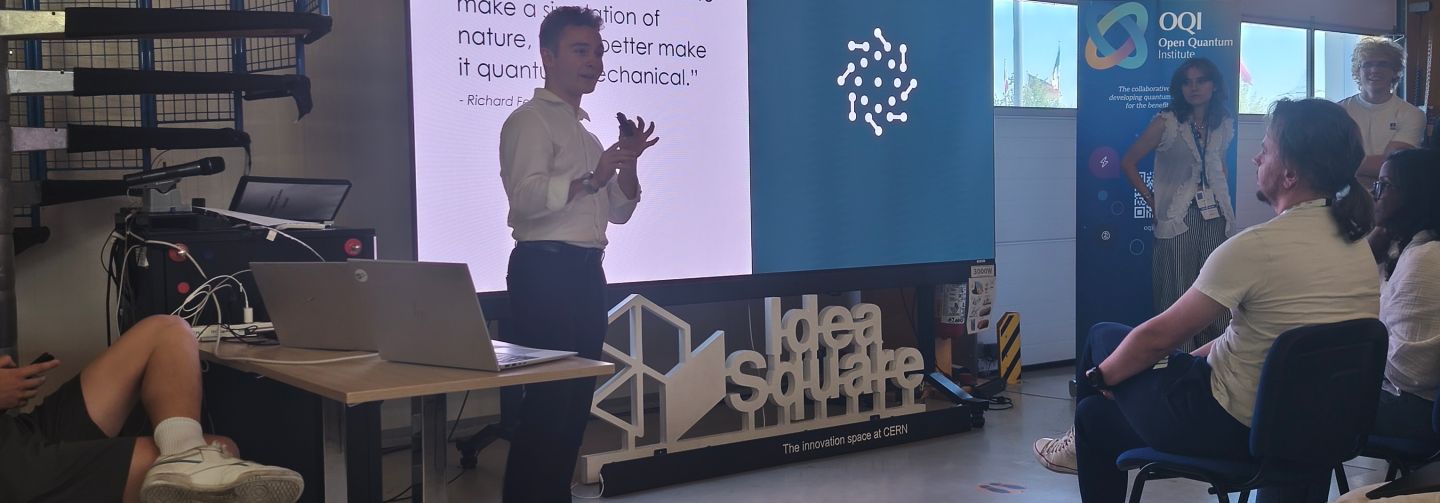
Photos credits: Traian Rares
Authors: Lucia Garbini, Augustin Freyche
From 10 to 12 July 2026, the Quantum Materials Hackathon 2026 was hosted at the CERN IdeaSquare. The hackathon organized by the Open Quantum Institute (OQI) at CERN brings together students and researchers to explore how quantum computing can help tackle one of physics’ most promising frontiers: quantum materials. Because the behavior of quantum materials is governed by quantum-mechanical effects, their simulation is believed to be as one of the areas where quantum computers may eventually offer real advantages over classical approaches.
Pasqal supported the hackathon as a challenge partner, providing a real-world problem to solve, access to our cloud infrastructure, dedicated training on Pasqal’s software stack, and on-site mentorship throughout the event.
Here is a look back at the challenge we set, how the team prepared, and what three days of quantum simulation at CERN produced.
The Challenge: A Quantum Twin of a real material
At the heart of this hackathon challenge was a practical scientific question: can a programmable quantum device help us better understand a real material?
The team worked on TmMgGaO₄, a frustrated magnetic material whose behavior has been mapped in previous studies, including Pasqal’s own recent demonstration of a one-to-one quantum simulation with 256 qubits.
“We framed the exercise in two steps.” Shares Tiago Mendes Santos, Senior Quantum Algorithm Developer in the Quantum Materials department at Pasqal, who together with his colleagues shaped the challenge.
“First, the students reproduced a familiar benchmark: preparing an antiferromagnetic state on a square array of atoms. This gave them a hands-on introduction to the workflow and to Pulser, without requiring them to start from a highly specialized materials problem.”
“The second step brought them closer to the real challenge. TmMgGaO₄ was mapped onto a triangular array, and the goal was to reproduce the material’s magnetization across its antiferromagnetic phase transition, using the same kind of simulation approach that has been used to connect neutral-atom processors with material-specific physics.”
What made the exercise especially interesting was the broader scientific context. Frustrated magnetic materials are studied because their competing interactions can lead to unusual collective behavior, and they remain an active topic in condensed-matter physics. In other words, this was not just a coding challenge: it was a compact example of how quantum simulation can be used to explore real questions in materials science.
The challenge fits naturally with the Open Quantum Institute’s broader approach: exploring quantum applications that may one day contribute to the Sustainable Development Goals, especially where better understanding of materials could matter for energy, climate, and resource efficiency. “Materials simulation is exactly the kind of use case that OQI wants to explore: it is rooted in real-world science, and it also offers a credible path toward applications with potential societal relevance over the longer term” said Yacine Haddad, Quantum Computing Advisor at the OQI and the CERN Quantum Technology Initiative (QTI).
Cloud Access, Pulser Training and On-Site Mentorship
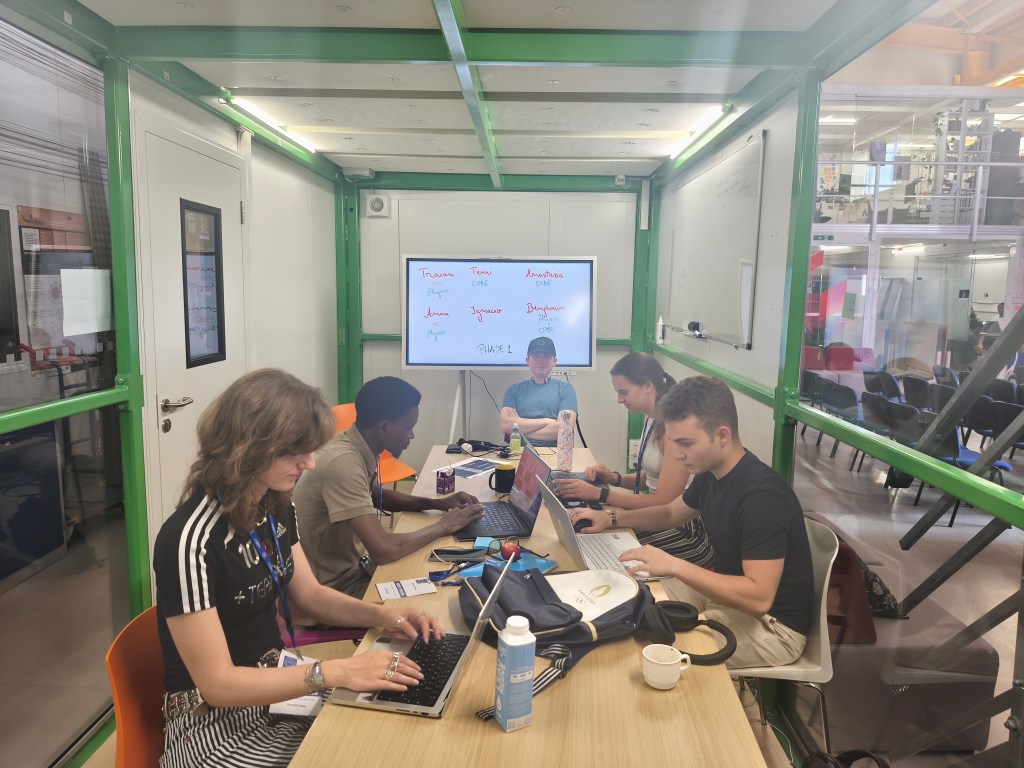
To help the team make the most of the hackathon, we supported them on three levels:
- On-site mentorship: Tiago Mendes Santos (Senior Quantum Algorithm Developer) and Vincent Martin (Technical Sales Manager), were there to guide the team through the technical and scientific parts of the challenge. They helped with debugging, answered questions, and supported the students as they connected their code to the physics behind the material.
- Cloud access: direct access to Pasqal’s cloud infrastructure gave the students room to test ideas quickly, refine their simulations, and work iteratively as the challenge evolved.
- Expert training: before the Hackathon, the team had access to Quantum Quest, Pasqal e-learning platform, and a dedicated hands-on training on Pulser, Pasqal’s open-source framework for programming neutral-atom quantum devices. The goal was not only to introduce the tools, but to help the students move from first principles to a working simulation workflow they could use confidently during the competition.
Three Days at CERN: From First Contact to Working Code
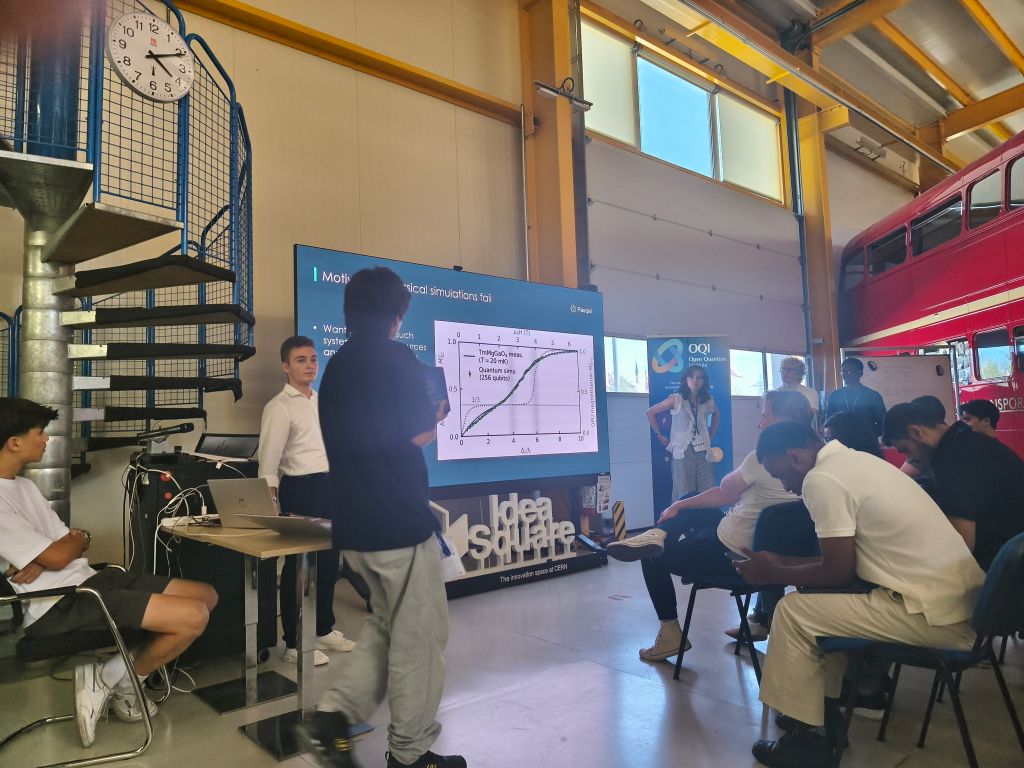
Although none of the team members had previously worked with neutral-atom quantum computing or the physics of frustrated magnets, they quickly got up to speed with both. Over the course of the hackathon, they completed most of the challenge, writing most of the required code for both phases, from preparing the antiferromagnetic state on the square array to mapping TmMgGaO₄ onto the triangular lattice.
The challenge also sparked discussions well beyond the implementation itself. Throughout the event, our mentors answered questions about Pasqal’s neutral-atom technology, the company’s work, and the broader outlook for quantum computing, reflecting the team’s genuine interest in the field.
Beyond the technical achievements, the team left with hands-on experience in neutral-atom quantum computing, a deeper understanding if its applications to quantum materials research, and a genuine enthusiasm to keep exploring the field.
That kind of learning-by-doing is exactly what makes this format valuable, and it aligns well with OQI’s broader interest in quantum applications that can connect strong science with longer-term societal relevance.
Hackathons like this one are a glimpse into the future of quantum computing talent. They bring students, researchers and industry experts together around problems that could shape the next generation of materials discovery. By supporting such events, training and mentoring a team, Pasqal invests in that future.
What the “FrusTrated Team” members say
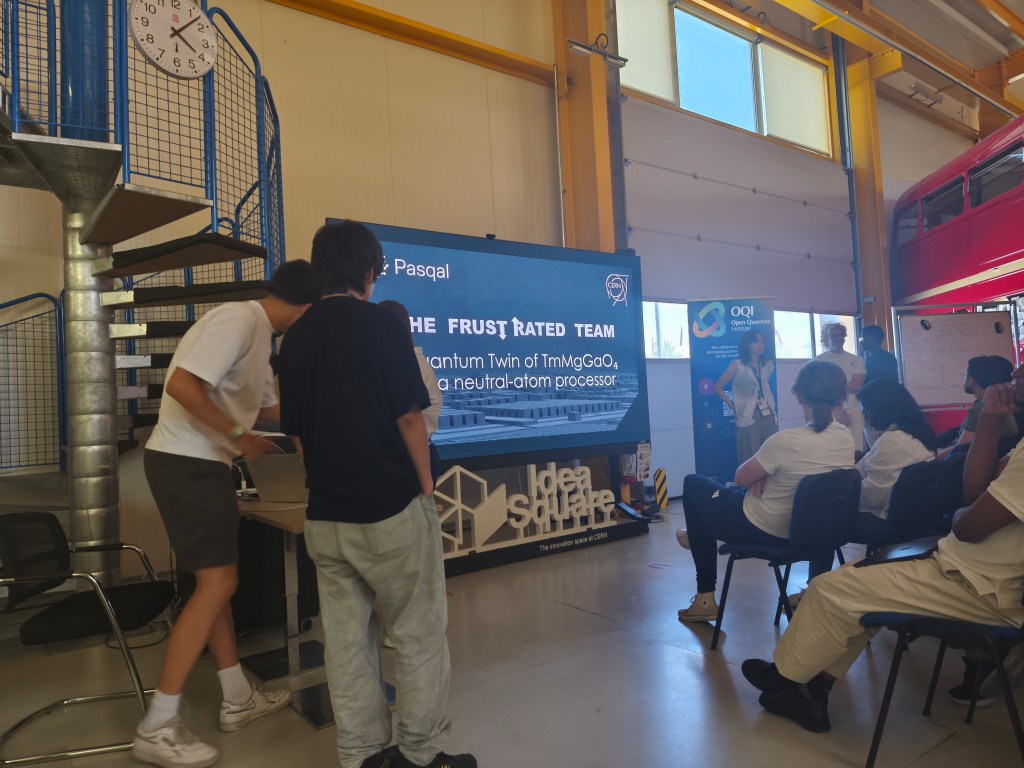
A big thank you to the students who took on this challenge, the and to everyone at the OQI, Quantum4Purpose and CERN who made this hackathon possible. The team’s own words say it best:
“The challenge was really enjoyable and stimulated teamwork, computational skills and physical understanding. We have definitely learnt a lot from it and would love to keep in touch regarding Pasqal’s aims and objectives in the near future.”
Traian Rares
“This hackathon was an amazing experience and having the opportunity to work with you all was very enriching 🙂 I learned a ton and had a great time throughout the whole challenge. Tiago and Vincent, you really helped us make the most of this cool learning opportunity, I think we all profited so much from your helpful insights, thank you! This challenge has opened my eyes to analog quantum computing for materials science research.”
Anna Huber
“Working with colleagues from different countries and backgrounds made this experience particularly rewarding. Beyond the technical aspects of simulating TmMgGaO₄ on a neutral-atom platform, I honestly enjoyed learning from each of you and seeing how different perspectives contributed to our progress.”,
Temidayo Oyewo
To Tiago and Vincent, our mentors on-site, and to every student who dove into the physics of TmMgGaO₄ with us: thank you for those three awesome days. We hope this is only the beginning of the conversation.
Join the Pasqal Community
To get up-to-date on the upcoming hackathons and the opportunities to start experimenting with Pasqal neutral-atom quantum computers, join Pasqal Community and you can:
- Get access to our e-learning platform Quantum Quest to learn from fundamentals to real-world applications in optimization and machine learning with neutral atom quantum computing
- Join conversations with peers, quantum experts, and quantum enthusiasts from academia and industry through our Slack workspace. Say Hello and get involved
- Be up-to-date on some events coming up soon that you don’t want to miss.