
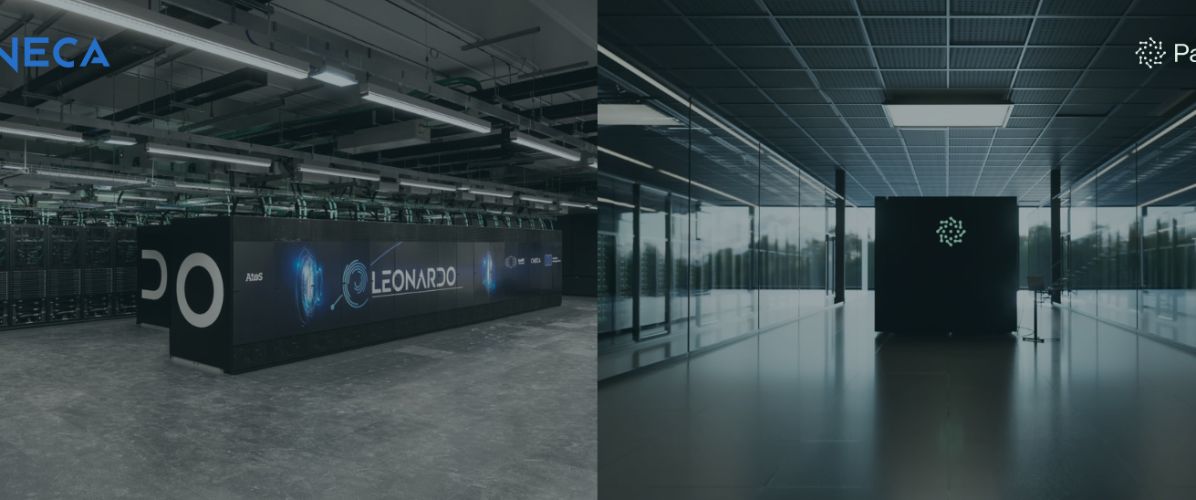
The new state-of-the-art quantum device, funded by the Italian Ministry of University and Research through the National Center ICSC and by the EuroHPC Joint Undertaking (EuroHPC JU), has been delivered by Pasqal to CINECA at the DAMA Technopole, strengthening the European hybrid HPC–quantum computing infrastructure
Paris, France – February 17, 2026 – A 140-qubit neutral atom quantum computer developed by Pasqal has arrived at the DAMA Emilia-Romagna Technopole in Bologna, at the site of CINECA, Italy’s largest public supercomputing operator and a member of ICSC – Italian Center for Research on High Performance Computing, Big Data, and Quantum Computing, making the center even more powerful. The new quantum computer is co-funded by the EuroHPC Joint Undertaking and, through ICSC, by the Italian Ministry of University and Research, which has been investing for years to make Italy a strategic hub of innovation and a leader in artificial intelligence and supercomputing in Europe and worldwide. This installation fits, in fact, into the broader European plan to develop a sovereign infrastructure of hybrid systems that combine high-performance computing (HPC) and Quantum Computing to provide researchers and SMEs with the computing capabilities needed to tackle increasingly complex scientific and industrial challenges in key sectors of the European economy.
The system delivered to Italy is a neutral atom quantum computer with over 140 qubits, engineered for tight integration with the Leonardo pre-exascale EuroHPC supercomputer, one of the world’s most powerful HPC platforms. This hybrid architecture will allow users to seamlessly offload specialized workloads – such as complex optimization problems, advanced materials simulation, and machine learning tasks – to the QPU, while relying on Leonardo for classical processing and large-scale data handling.
“Thanks to the clear strategic vision of the Ministry of University and Research, particularly Minister Anna Maria Bernini’s, synergistic with the European strategy for the development of quantum computing, and its ongoing commitment and support to implement it, Italy can now claim to be at the forefront of advanced computing capabilities at global level”, said Antonio Zoccoli, President of the ICSC Research Center. “When the integration of the Pasqal quantum computer with Leonardo becomes operational in the coming months, the national scientific community and industry will have computing resources at their disposal that will strengthen their competitiveness and be a useful tool for sustainable growth”.
This deployment contributes directly to Europe’s ambition to foster hybrid computing systems adoption across the Union. The integration of the system with Leonardo is expected to become fully operational and available to the academic and industrial research communities in the coming months.
Pasqal, a global leader in quantum computing, co-founded by Physics Nobel Prize winner Alain Aspect, is already operating two quantum devices under the EuroHPC JU project, at CEA/GENCI in France and Forschungszentrum Jülich (FZJ) in Germany. With the Italian installation, Pasqal now powers three of the eight quantum computers deployed under the EuroHPC JU, confirming its position as a key technology leader in the provision of European quantum computing infrastructure and reinforcing European supply chain with pioneering quantum computing capabilities.
“The delivery of this QPU to CINECA is a new milestone for European quantum computing,” said Loïc Henriet, CEO at Pasqal. “By coupling our neutral atom quantum technology with Leonardo, CINECA is enabling researchers to explore computational frontiers that were previously out of reach. This deployment further reinforces Pasqal’s role as a strategic actor to deliver Europe’s hybrid HPC–quantum federated infrastructure in the ground.”
About Pasqal
Pasqal is leading the industrialization and deployment of neutral atom quantum computing, transforming Nobel Prize-winning research into real-world solutions for industry, science, and governments. Since 2019, the company has built high-performance quantum systems and cloud-ready software that tackle the world’s most complex challenges in optimization, simulation, and AI. With a truly global footprint — including teams and facilities across Europe, North America, and Asia — and backed by over $215 million from international investors, Pasqal is accelerating the adoption of robust, high-performance quantum computing.
About ICSC
ICSC – Italian Research Centre on High Performance Computing, Big Data and Quantum Computing is one of five National Centers established and funded under Mission 4 “Education and Research” of Italy’s National Recovery and Resilience Plan (NRRP), dedicated to strategic sectors for the country’s development under the “From Research to Business” framework. ICSC’s mission is to carry out, manage, and coordinate research and development activities at both national and international levels, fostering innovation in computational and data storage technologies, including hardware and software solutions for simulation, computing, and data analytics. The Centre aims to build a globally attractive ecosystem that supports research, industry, and society, strengthening Italy’s competitiveness and sustainable growth.
These goals are pursued by federating and enhancing existing national resources and by developing a state-of-the-art cloud-based supercomputing and big data infrastructure. ICSC brings together leading Italian expertise and activities while training highly skilled professionals across its ten key scientific domains.
About CINECA
Founded in 1969, CINECA is a interuniversity consortium bringing together 121 member institutions, including two Italian Ministries (the Ministry of University and Research – MUR, and the Ministry of Education and Merit – MIM), 70 Italian universities, and 49 national public institutions (15 research organizations, 10 university hospitals and IRCCS, 19 AFAM institutions, and 5 agencies and public bodies). CINECA supports and drives digital transformation through innovation, designing and developing advanced technological solutions, building integrated, tailor-made platforms for its members, and delivering services that support public bodies and administrations. It is also one of the world’s leading computing centers and among the most advanced in High Performance Computing (HPC), with activities ranging from infrastructure management to the development of cutting-edge applications, as well as the co-design of technological solutions and research and innovation projects. Acting on behalf of the Ministry of University and Research, CINECA represents Italy in PRACE (the Partnership for Advanced Computing in Europe), serves as a hosting entity of the European High Performance Computing Joint Undertaking (EuroHPC JU), and participates in the ITER nuclear fusion project.
About EuroHPC JU
The EuroHPC JU is a legal and funding entity that brings together the European Union and participating countries to coordinate efforts and pool resources with the objective of making Europe a world leader in supercomputing.
The EuroHPC JU is currently deploying a European Quantum Computing infrastructure, integrating diverse European quantum computing technologies with existing supercomputers. To date, the EuroHPC JU has procured six quantum computers, located across Europe. Three of these systems have already been inaugurated: PIAST-Q in Poland, VLQ in Czechia and Euro-Q-Exa in Germany, marking a milestone in Europe’s leap into the quantum era.
The deployment of these quantum computers across Europe aims to offer the widest possible variety of European quantum computing platforms and hybrid classical-quantum architectures, including analog quantum simulators based on neutral atoms, trapped ions, superconducting circuits, and photonics to adiabatic systems, enabling the execution of annealing routines. This approach positions Europe at the forefront of this emerging field while providing European end-users with access to diverse and complementary quantum technologies.
In addition to these six systems, two analog quantum simulators, Jade and Ruby, have been procured under the EuroHPC JU project HPCQS and inaugurated end of 2025 in France (GENCI) and Germany (Julich Supercomputing Centre, JSC).
Procurement processes are also currently ongoing for two additional EuroHPC quantum computers to be hosted and operated by SURF in the Netherlands and by LuxProvide in Luxembourg.
In addition and to equip Europe with a cutting-edge supercomputing infrastructure, the EuroHPC JU has already procured 12 supercomputers, distributed across Europe including JUPITER in Germany, and Alice Recoque, Europe’s first exascale systems.
European scientists and users from the public sector and industry can benefit from EuroHPC supercomputers via the EuroHPC Access Calls no matter where in Europe they are located, to advance science and support the development of a wide range of applications with industrial, scientific and societal relevance for Europe.
Currently, the EuroHPC JU is also overseeing the implementation of 19 AI factories (AIF) across Europe, complemented by 13 AI Factory Antennas, to offer free, customised support to SMEs and startups.
The EuroHPC JU also funds research and innovation projects to develop a full European supercomputing supply chain, from processors and software to applications to be run on these supercomputers and know-how to develop strong European HPC expertise.
With the recent adoption of Council Regulation (EU) 2026/150, the EuroHPC JU’s mandate has been expanded with new action pillars dedicated to the deployment of AI Gigafactories across Europe and the advancement of quantum technologies.

