

Photo credit: ©VivaTech 2026
Author: Laura Vinel
Over four days, Europe’s largest technology conference brought together 180,000 visitors from 171 countries.
Throughout exhibits and panels, the maturation of quantum computing became evident, transitioning from a research curiosity to operational infrastructure.
Pasqal’s participation spanned multiple dimensions: a Purple Stage keynote, visits from government officials visit, a strong presence on Scaleway’s stage and strategic expansion in Canada. Here’s what happened.
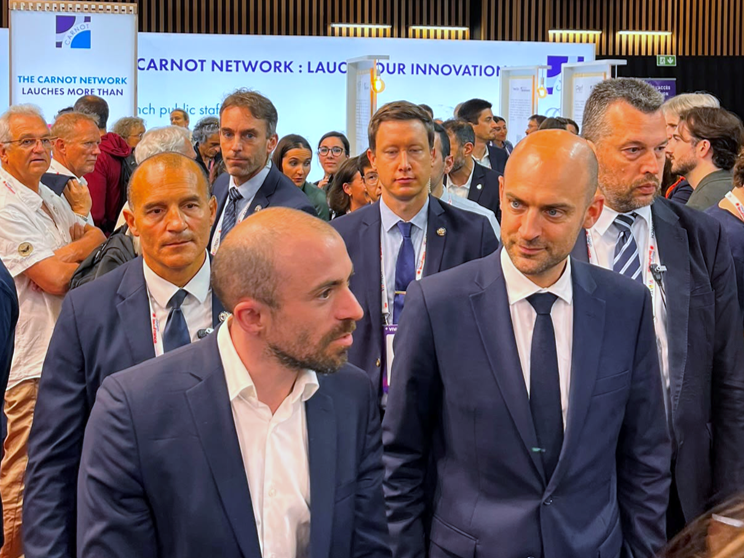
Loïc Henriet, CTO of Pasqal, alongside French Foreign Minister Jean-Noël Barrot during the VivaTech 2026 exhibition. © Pasqal
Why Quantum Matters Now
VivaTech’s tenth edition made one thing crystal clear: quantum computing isn’t a future technology. It’s operational infrastructure.
France’s Quantum Zone proved it. Pasqal, Alice & Bob, C12, Quandela, and Quobly (all five backed by the national sovereign quantum program PROQCIMA) presented deployed systems tackling real industrial problems.
For Pasqal, the message was singular: neutral-atom quantum processors are moving from prototypes to production infrastructure at national labs and research facilities across Europe and North America.
Cutting Through Hype: The “When Will Quantum Deliver” Panel

Loïc Henriet on the Purple Stage at VivaTech 2026, in a panel titled “Quantum Leap: When Will Quantum Computing Deliver Real Business Value?” alongside IBM, Fraunhofer, and McKinsey. © Pasqal
A 45-minute discussion on the Purple Stage, titled “Quantum Leap: When Will Quantum Computing Deliver Real Business Value?”, brought together perspectives from industry and research.
Speakers included Loïc Henriet, CTO and Managing Director of Pasqal, Jerry Chow, IBM Fellow and Chief Technology Officer for Quantum-Centric Supercomputing at IBM and Axel Müller-Groeling, Executive Board Member for Research Infrastructures and Digital Transformation at Fraunhofer-Gesellschaft. The moderator, Henning Soller, Global Leader of Quantum Computing Practice at McKinsey & Company, Inc., pushed past marketing claims to address a persistent question: what concrete evidence exists that quantum processors solve problems classical systems cannot?
Several themes emerged:
- On the topic of quantum advantage, Loïc Henriet highlighted the importance of focusing on real-world applications rather than theoretical benchmarks. Referencing recent research published in Nature, he noted that quantum processors are beginning to demonstrate their ability to model the behaviour of complex materials in ways that can complement existing classical computing approaches.
- Hybrid architectures are becoming standard. Future enterprise computing environments are expected to combine CPUs, GPUs, and quantum processors, each optimized for specific workloads. This is not a replacement narrative—it’s a coexistence model.
- AI and quantum may reinforce each other. Quantum processors could generate high-fidelity datasets for AI training, while AI algorithms optimize quantum circuit design. The two technologies may be more complementary than competitive.
- Near-term applications concentrate in specific domains: financial portfolio optimization, drug discovery, materials chemistry, and energy systems modeling. These aren’t hypothetical use cases. Pilot programs are underway.
Why Governments Are Betting on Quantum
A striking element of VivaTech was the presence of public-sector stakeholders. France’s Minister for Europe and Foreign Affairs, Jean-Noël Barrot, visited the Quantum Zone.
Pasqal believes that the state-level strategic significance of quantum computing is straightforward. Quantum processors could impact cryptography, materials discovery for defense applications, and scientific research with geopolitical implications. Nations that lag in quantum capability may risk dependency on foreign vendors, which would be an unacceptable position for strategic technology.
Europe’s investment in the quantum industry reflects this logic. The EU Quantum Flagship has allocated €1 billion over ten years. France’s PROQCIMA commits €500 million. Similar programs exist in Germany, the Netherlands, and the UK. The result: a race to translate academic research into operational infrastructure.
Cloud Access: Pasqal on the Scaleway Stage
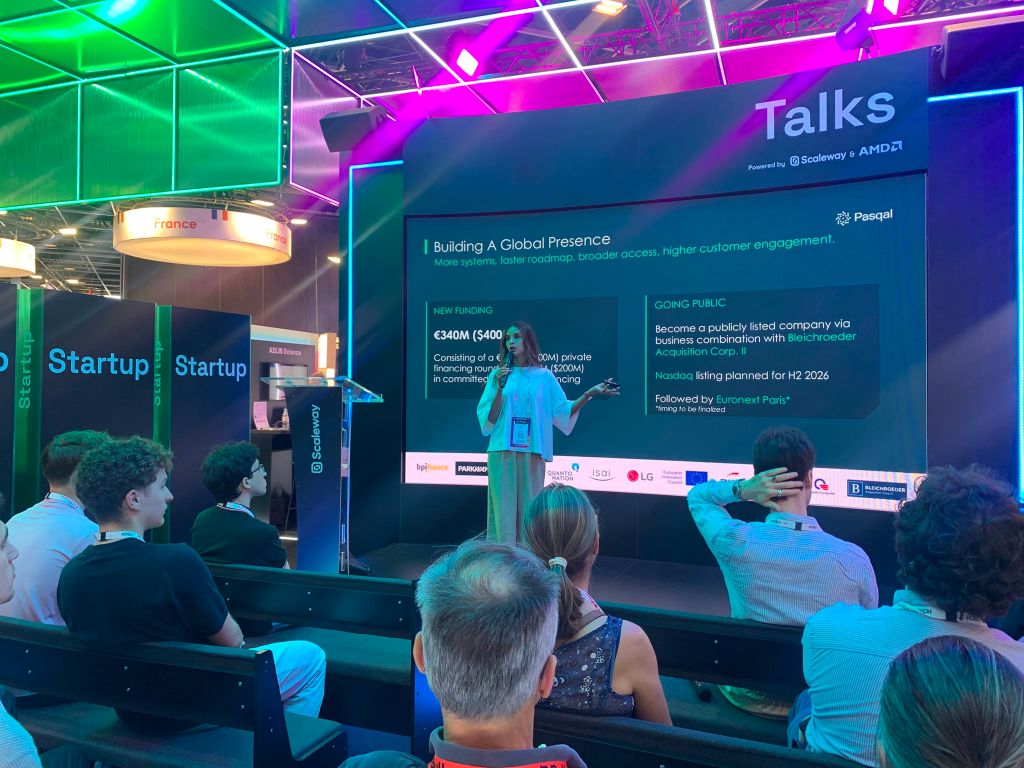
Lina Alzate, Senior Regional Sales (Europe), presents Pasqal’s global growth strategy at the Scaleway Talks stage. © Pasqal
Pasqal presented on Scaleway’s stage and maintained a booth presence, discussing QCaaS (Quantum Computing as a Service) strategy and international expansion roadmap.
The theme: democratizing quantum access. Researchers and enterprises don’t need to own hardware. They need on-demand, pay-per-use quantum computing. This model addresses a fundamental barrier to quantum adoption.”
North America Expansion: Sherbrooke as Quantum Hub
Pasqal’s growth isn’t confined to Europe. In June 2025, we opened a 100-qubit quantum processor manufacturing facility in Sherbrooke, Quebec, our second production site globally.
Backed by Investissement Québec, the facility sits within Espace Quantique 1 in the DistriQ Quantum Innovation Zone. The QPU is integrated into PINQ²’s hybrid computing platform, making it accessible to researchers and institutions across the region.
At VivaTech, Québec’s Vice-Premier Minister toured our quantum demos.
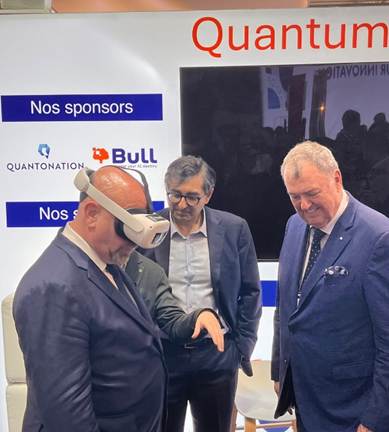
Ian Lafrenière, Québec’s Vice-Premier Minister experiencing Pasqal’s immersive quantum demonstration at the Quantum Zone. © Pasqal
What VivaTech Revealed
VivaTech 2026 highlighted the continued maturation of the quantum computing sector. Across the exhibition floor, discussions focused on deployed systems, research collaborations, industrial partnerships, sovereign technology initiatives, and the infrastructure required to support future growth.
For Pasqal, the week reflected the breadth of the company’s activities across research, industry, public-sector engagement, and international expansion.
More broadly, the event illustrated how quantum computing is increasingly becoming part of conversations around advanced computing, alongside classical and AI-driven technologies, as organisations continue to explore potential applications across scientific and industrial domains.